Tuesday, August 6, 2024

Rites of Passage

 I don't know when or how it happened, but I've been keeping some sort of record of things since I was a youngster. It seems it has always been a natural tendency of mine to jot down things in words, drawings or both and in these latter years I've discovered that it's become a kind of vouge thing to do either in an attempt at lay people indulging in more creative habits or as a type of  popular, therapeutic self-care. It's become more prominent in the mainstream, in no small part, since the advent of social media because so many "gurus" of mindfulness suddenly appear out of nowhere as "experts" on ways to release one's demons through journaling , to use a popular term. 

It brings to mind the Barbara Mandrell hit from 1981, I was Country when Country wasn't Cool because all the newly discovered ingenious methods of healthful practices are things I've been doing for decades. Stopping just short of saying I was bullied for it, I took much kidding and razing throughout the years for doing such things. The harassments continued even well into adulthood. Now, with a nod toward Ms. Mandrell,

Look at everybody trying to be what I was then.

I confess my pride about how It gives me sense of victorious satisfaction to know that the things that the undesirable people in my past who often tyrannized my preferences by chasing me down hallways after school to rip up my collections of drawings and notes or who took the books I was reading and ripped the pages out of its binding, are the ones now trying to mimic me, even though they would never admit it. Okay, so maybe it could be described as bullying but it was at a time when bullying was seen as more of a rite of passage.

Who am I to Argue

 There was once a prospector of long ago who had set up camp for the night after a hard day of prospecting. He was frying bacon and brewing coffee over his campfire, anticipating a lovely dinner under the open, star filled sky among the soothing sounds of crickets when he heard a rustling in the brush getting closer and closer.

By and by, a sizable, thickly bearded man dressed all in leather emerged riding a grizzly bear which he was controlling by a tight grip on his furry neck with his strong, large hands. He rode right up to the camp and said in a gravelly voice, "I'd be obliged for a swallow of coffee".

Not being one to turn away people in need and taking into consideration the riders imposing size and roughness, the prospector agreed and the stranger, without getting down from the grizzly, reached for the scalding hot coffee pot, grasped it with his bare hands and poured half of its scalding contents down his throat without a wince. He wiped his mouth with his leather sleeved arm, replace the coffee pot onto the fire and said,

 "Many thanks. I hate to run off so rudely but there's a man chasing me and he's one bad son-of-a-bitch."


Thursday, July 25, 2024

Talent ot Passion, Which is it?


 In the book The Algebra of Wealth by Scott Galloway, the author suggests we follow our talent, not our passion. I, for one, tend to agree with this philosophy because typically, those who advise us to pursue our passions are already rich. The author wisely states it's important to have a primary source of income and have a side gig we are building in the process. We have to pay our bills while building a side hustle and not only that, it provides diversified income. 

I must confess that most of the time over the last decade, I have relied on income from my window washing business to get me from month to month while building (and continuing to build) my graphics business which is, for now, drawing caricatures at live events. 


In fact my "passion" does not even rest with drawing caricatures, logo design or illustrating and it certainly isn't window washing or any other labor for that matter.  If I were to "follow my passion" as they say, it would probably be related to cooking 

but don't expect to see me behind 
anyone's counter as a short order cook. 

My passion for cooking can be better described as a hobby and would be more outdoor cooking with a fishing rod in one hand and a cigar in the other. Nearly everything else I do, including commercial art, is a means to an end and that is financial security

Once that end is realized then I may 
be free to pursue that passion abundantly.

When it comes to creativity I most love drawing what I want to draw and then maybe try to sell it but this method has a slim chance for financial success. In fact, that's where the expression "starving artist" originated and the galleries and art shows are full of them. My modus operandi is to draw what people ask me to, then draw it, and they buy it. This formula has a 100% rate of success for me and while I'm at it I can still pitch my other works of art and merchandise.


Tuesday, July 23, 2024

Youth is Wasted on the Young

Reprinted from my book,


It's a youth oriented world...

Many have spent a lifetime wondering if they could have made a contribution with their talents and many go to the grave still wondering.

Rich Karlgaard wrote a book entitled Late bloomers and in it he explains the tendency in America to espouse a youth oriented culture. The media and society in this country favors early success and the prevailing attitude among many is that if you haven't struck it rich by age 30 you have  missed the boat and somehow doomed to a life of mediocrity.

This is not only untrue but would be terrible news to the millions of late bloomers who have yet to hit their stride.

Many don't hit their stride till their later years which is testament to the value of years of life experiences innate in late bloomers and their potential contributions. 

It can be early programming as in my case that slows things down but many times it takes wisdom and experience to discover it. 

I'm impressed with today's youth who find their calling early, go on to great success and they deserve all the credit they have coming to them but when you look at the statistics the odds are not in favor of early success.

I'm also impressed with the late bloomers who discover their purpose after years of tempering and hardening:

  • Harland Sanders was 65 when he created Kentucky Fried Chicken.
  • Rodney Dangerfield's first break was the Ed Sullivan show at age 46.
  • Duncan Hines was 55 when he wrote his first book on food and hotels. At age 73 he licensed the rights to use his name on cake mixes.
  • Julia Child's first TV appearance was at age 51.
  • Laura Ingalls Wilder was 65 when she published Little House on the Prairie.
  • Jack Cover received a patent for the taser gun at age 54.
  • Harry Bernstein published his first book at 93. Before that he was a freelance writer and editor till age 63.
  • Peter Marsh Roget was 69 when he began Roget's Thesaurus and completed it at age 73. He improved upon it until his death at 90.
  • Kathryn Jooster was 42 when she began pursuing an acting career. She played bit parts till age 66 when she won an Emmy for her role in Desperate Housewives.
  • Anna Mary Robertson, Grandma Moses, started paintng in her 70's. Her work was displayed in New York's Museum of Modern Art at age 78. She was 92 when she wrote her first book.
  • Edmund Hoyle wrote Rules of Card Games at 70.
Abraham Maslow put forth his hierarchy of needs in The Theory of Actualization. He said not only is it vital to live uo to our full potential but it is also our moral obligation to do so.


"Musicians must make music. Painters must paint. Poets must write if they are to be ultimately at peace with themselves. What humans can be, they must be. They must be true to their own nature."
                                              Abraham Maslow

My mistake, and the mistake of so many others, has been the mismanagement of priorities. I've given undue regard to my early programming and the social expectations competing for my attention. I deferred to my fears in order to satisfy my sense of security which led to unhappiness and, in an ironic twist, I never found the security I sought.


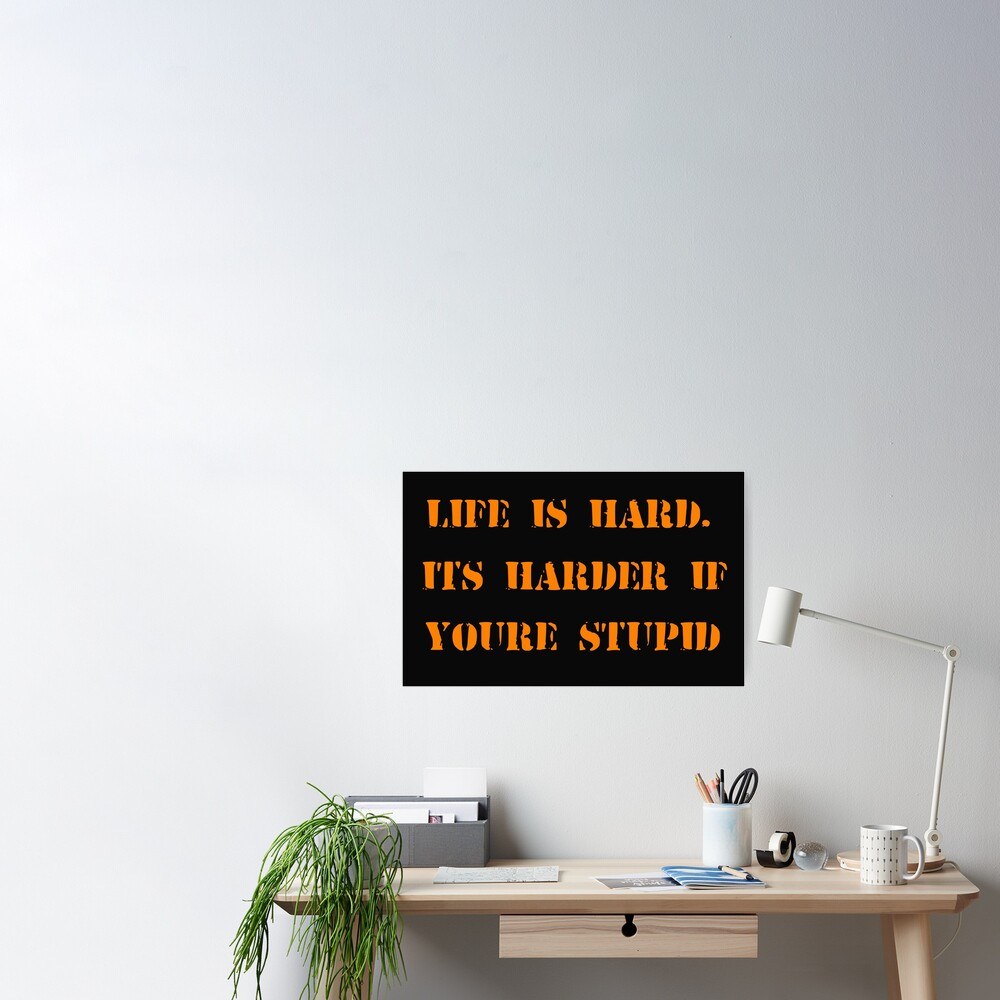
Life is hard. It's Harder if You're Stupid

Sunday, July 21, 2024

I Do but I Don't

These words were written by the immortal Ernest Hemmingway and even though it was specifically penned for the subject of writing, the same could be said about nearly any project or endeavor ever conceived. Substitute, if you will, the word "writer" and "writing" for another venture:

  • Artist/drawing
  • salesman/selling
  • runner/running
  • cook/cooking
I often doubt if I truly want to do any of the things I say I want to do  because so often I might choose to take a nap instead, or watch TV, or surf the web or anything else unrelated to my stated desires. 

The late Brian Klemmer wrote in his book 

If How-to's Were Enough We Would 
All be Skinny, Rich and Happy

that if we set a goal to make $100,000 a year but instead we made only $70,000 then we really didn't want to make $100,000. We say we did but our deeper, more focused desire was, instead of doing what was necessary to reach the goal, we were unwilling to do something uncomfortable, or something that would make us look ridiculous. Maybe we didn't want to to do something that would be interpreted as pushy and as a result, we lost sales and we fell short of the goal we set. 

This can be said of anything we say we want to do. What is the stronger desire?


Tuesday, July 16, 2024

The Geek and Pablo Picasso


There's a story of a business whose internet crashed and in a panic, the owner reached out to the nearest computer expert to solve his problem. Not long after, the computer geek showed up with his clip board, wearing a white shirt and thin necktie and he was shown by the owner where the servers were located
.

The repairman leaned over and looked at some flashing red and green lights and exclaimed, "aha".

He placed his clip board down, reached behind the server and gave it two gentle taps and just as he did, everything was back online.

"Thank you so much!", said the owner. "You've saved my business and I don't know what I would have done without you! How much do I owe you?"

At that, the repairman pulled out his invoice booklet, wrote down a number and handed it over to the owner.

With horror the owner exclaimed "A thousand dollars? Why, that ridiculous! You were only here for 5 minutes and all you did was tap the server! I want an itemized invoice!"

So the meek repair man wrote another invoice only this time it read, 

Tapping the server.......$1

Knowing where to tap......$999

There's another story of a lady who was drinking a cup of coffee at an outdoor cafĂ© in Spain who was seated directly behind the famous painter, Pablo Picasso. 

Pablo was sketching on a paper napkin and as he was working his magic with his pencil the lady was watching from behind. 

Eventually, having finished his coffee, Pablo rose to leave with his sketch when the lady stopped him and said, "Excuse me, Mr. Picasso. I was watching you while you were drawing and I was truly impressed. May I please buy it from you?"

"Certainly" he answered, "It's $500 dollars."

The lady was shocked and said "That's a lot of money for a pencil drawing that you did on a paper napkin and it only took you 5 minutes to draw."

"No ma'am your wrong" said Pablo, "it took me 50 years." then he put it in his pocket and walked away.

Tuesday, July 9, 2024

The Man Who Didn't Play Checkers With Einstein


Not everyone’s life has transformational moments that set one’s life on a different course as did George Allen’s. During the 60’s and 70’s, George Allen was one of the most eccentric, superstitious and winningest coaches in pro football.

But in 1944 he was a midshipman at Princeton, and he became obsessed with meeting Albert Einstein, also at Princeton. He heard that Einstein was a checkers player, and George became obsessed with the desire to challenge him to a game so one Sunday after church, George walked to Einstein’s off campus house and knocked on his door. Einstein answered, George introduced himself and told him of his intentions and asked the Professor if he would oblige.

Einstein said he was not much of a checkers player but after being persuaded by George’s pleading, he reluctantly agreed and said he did not own a checker board and asked George if he had brought one. George had not, so they said their goodbyes and George turned to leave.

On his way back to campus George began an extended, self-lacerating, internal dialogue. What haunted him wasn’t the fact that he forgot the checkerboard because he had not. In fact, he strongly considered bringing it but what stopped him was the thought that walking across campus to church and then into town caring a checkerboard would make him look crazy.

Having lost an opportunity, George made a vow never to worry about what people thought of him ever again and by the time he took the coaching job with the LA Rams in 1966, he had left it far behind.

George Allen was a winning coach and was known and sometimes ridiculed for his eccentricities but after the Einstein experience, he let them talk. He was a perennial playoff team with the L.A. Rams and Washington Redskins and also won the NFC Conference Championship in 1972.